The peak in Australia's advertised salaries growth has already long since been and gone, according to SEEK's excellent advertised salaries index.
Source: SEEK
Also, via the FWC this week, it's clear that wages increases remain modest in Australia:
New Zealand's central bank seems crazily hellbent on hiking interest rates into a deep recession, but there seems to be little pressing need to Australia to follow them down that misguided path.
That's especially the cases with visas now being processed at warp speed, with 3.4 million applications processed since June 1.
Inflation is also set to fall way in the US over the months ahead, with the price of gas crashing from above US$5/gallon to just $3.64/gallon.
Australia's fuel prices have calmed down too, but diesel prices remain frustratingly high.
A couple of decades ago I lived in the south-east of England (a crowded trade if ever there was one!).
There were theories doing the rounds, even in the pre-Youtube days, that as the Baby Boomer generation moved on the population of the UK would halve, effectively leaving the island half empty.
It never made any logical sense, and in any case it contradicted the evidence of my own eyes, which could see towns and cities sprawling at a very rapid pace, worsening traffic queues, crowded schools and hospitals, and so on.
Between the most recent two Censuses the English population continued to expand rapidly by around 3½ million to more than 53 million.
To state the obvious, that's an awful lot of people - and extra people! - for such a small space.
It's a lot, however you may try to position it, particularly due to the gravitational pull of London and the south-east of England.
A little while ago the Office for National Statistics (ONS) forecast that the England population would grow by a further 3½ per cent over the course of this decade, with the total UK population expanding by 3.2 per cent to 67.1 million by 2030.
Not all that surprisingly this has been causing significant angst in some towns and cities, and the desire to "take back control of the borders" was arguably a key swing factor in the controversial 2016 Brexit referendum, which ultimately voted 52 to 48 in favour of leaving the European Union.
UK hits record immigration
Ironically, despite the government's strong rhetoric, there has been no apparent "taking back control of the borders" to speak of, however loosely that may be defined.
Statistician and social commentator Jamie Jenkins forecasts that more than 50,000 migrants will cross the channel in small boats this calendar year alone.
Approximately half of the migrant crossings are accounted for by Albanians, overwhelmingly male.
Where I stay when in the UK, half a dozen of the town's local hotels are reportedly being used to provide accommodation for the new arrivals while the Home Office processes asylum seeker claims.
These local stories can be beaten up, no question, but the headline numbers and associated costs are real enough.
Yesterday the ONS also reported that the net immigration figures for the year to June 2022, which showed more than 1.1 long-term immigration million arrivals, for a net immigration figure of a staggering +504,000.
Source: ONS
Students accounted for a large part of the surge, taking the net immigration figures into the UK to the highest level on record.
After accounting for the natural growth in the population this clearly implies that the population forecasts for the decade are significantly undercooked.
Global war for talent
Germany and some other European countries have already gone done the mass immigration route, with decidedly mixed results.
Recently Canada announced that it would be targeting a huge immigration programme over the coming years.
This suggests that there could be something of a global 'war for talent' afoot in the years ahead.
Hong Kong has dropped out of the race as its talent pool is drained following the en masse exodus of graduates and skilled workers.
What next for 'Big Australia'?
The Big Australia debate has been tarnished over the years since the mining boom glory years, since anyone daring to question what the 'appropriate' level of immigration might be is immediately tarnished with the xenophobia brush by big business and other vested interests.
But in the context of what's happening in Germany, the UK, Canada, and elsewhere, it's a vitally important debate for the functioning of the country, which merits a fair discussion.
Home Affairs recently announced that Australia had processed 3 million visas since June, reducing the backlog to around ¾ million.
Yesterday, Andrew Giles updated Parliament in noting that 3.4 million visas have now been crunched through since June 1.
That accounts for a big chunk of the backlog, and it's fairly clear what direction things are currently heading in.
But what comes next?
Australia is already likely to see its population increase from 26 million to 29 million by the end of 2030, based on the current trajectory and forecasts.
An inquiry is due to be held over the coming few months into the role of permanent migration and nation building.
The big picture is that if Australia goes down the 'Big Australia' route the population could feasibly increase to around 50 million by 2050, and...who knows, perhaps 100 million by 2100?
Of course, I'm acutely aware as an immigrant that it's not really my debate to get involved in.
But clearly the question which needs to be asked and answered transparently is whether that is the goal, and whether the benefits outweigh the costs?
This week I was joined by Melinda Jennison from Streamline to discuss what's happening in Brisbane's housing market, following on from recent headlines.
Yep, the inflationary 'belch' is passing...and it looks as though inflation is going to start falling fast.
It might take some time to hit the official figures, but it's surely in the post now.
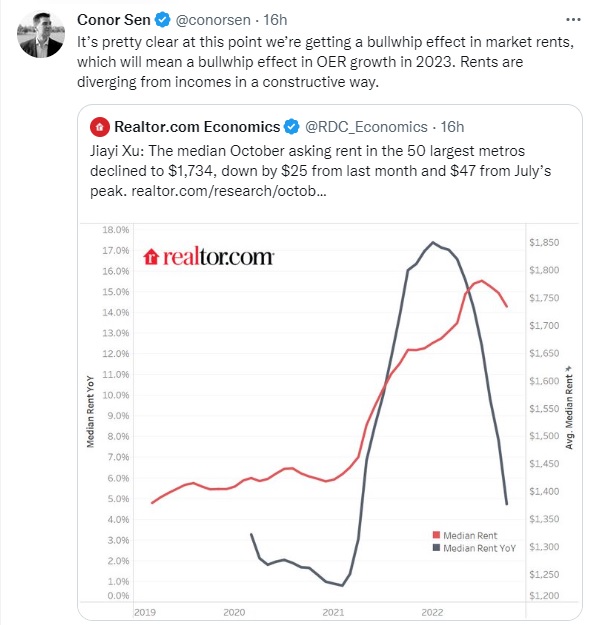
US rents are now falling across most private sector measures (and rents have been a huge part of the US services inflation story).
Elsewhere, there was a huge miss on producer prices in Germany, which fell by more than 4 per cent in October, for the biggest monthly drop in history (largely driven by energy-related costs).
Of course, this partly reflects that Europe is sinking into a nasty recession, but it's also a sign of what's to come from an inflation perspective.
The inflation narrative will turn around over the coming months, and it will likely evaporate as fast as it appeared.
Hopefully we'll be talking about falling interest rates again sooner rather than later, after a brutal salvo of hikes.
---
11 days ago National Australia Bank made amendments to rental shading, which increased borrowing capacity by 8 per cent for some borrowers.
Today, Commonwealth Bank of Australia made tweaks to its HEM calculations, which will similarly increase borrowing capacity for some investors.
Source: Eric Wu, broker channels
Unfortunately, many would-be borrowers are completely shut out of the market (or trapped in a mortgage prison on woeful mortgage rates) because of the extraordinary 300 basis points lending assessment buffer, which was introduced when the cash rate target was 10 basis points.