Tuesday, 26 July 2022

US recession risks rise

Soft landing for the US?

A few choice charts via the Twittersphere to illustrate how market expectations have been evolving for interest rates (which is to say, they're most probably heading up, then fairly soon back down again). 

Firstly, US manufacturing is sinking into recessionary territory, and an interesting chart via Andreas Steno Larsen and Macrobond suggests that bond yields will accordingly be heading lower, and perhaps sharply lower. 


Secondly, 5-year inflation expectations have now slumped below the 2 per cent inflation target, suggesting that markets are becoming increasingly concerned interest rates may be tightened too far (hat tip to David Scutt, with the share). 

Markets are pricing for a 75 basis points hike at Wednesday's FOMC Meeting. 


And thirdly - and finally - financial markets expect the US Federal Reserve to hike rates towards 3½ per cent by the end of the calendar year, but then to be delivering a series of cuts in 2023 and 2024, to sink the Federal Funds Rate back below 2½ per cent by early 2025.


Source: Charlie Bilello


---

Walking the tightrope

There's a similar tightrope to be walked in Australia, with policymakers aiming to ratchet up interest rates far enough to tame inflation over the remainder of 2022, but without going so far as to sink the economy back into recession next year.

The Reserve Bank of Australia's Governor Lowe noted in a speech last week that inflation expectations derived from indexed swaps suggest a high degree of confidence that inflation will average 2 point something over the decade ahead, but over the next year inflation is expected to be above the target range. 

The Governor's speech appeared to suggest that a combination of a salvo interest rate hikes to cool demand combined with easing disruptions to supply chains should bring inflation back down to the target range in a reasonably timely manner. 

Commodity prices have fallen sharply over the past month, which will help. 

On a related note, tomorrow will see the release of the June quarter inflation figures for Australia.

Markets are looking for the headline result to slow from 2.1 per cent in Q1 to 1.9 per cent in Q2.

But that would still be enough to see an annual figure of above 6 per cent, with consumer price increases largely driven by the housing component, food, and fuel prices in the June quarter. 

Core inflation is expected to come in at a similar level to Q1, when it printed at 1.4 per cent for the trimmed mean measure (and 1.2 per cent for the weighted median).

Monday, 25 July 2022

2022 Investor Report

Free Investor Report

You can download for free here (or click on the image below):

Sunday, 24 July 2022

Wealth leaves BRICs

High net worth movements

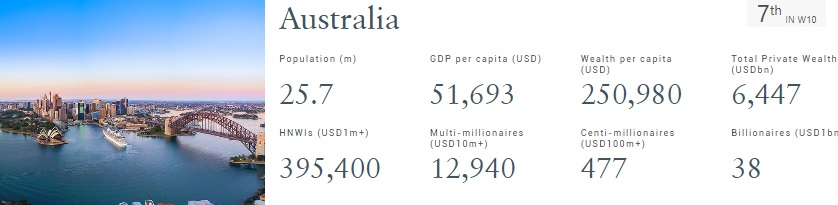
Henley's latest Global Citizens Report projects a large outflow of high net worth individuals from Russia, India, China, and now Hong Kong and Ukraine.


Source: Henley

The main  beneficiaries will be the UAE and Australia, forming part of a broader trend to shift wealth, once acquired, from Russia, China, and India. 


Over the next decade, Henley projects an increase of 80 per cent in India's high net worth individuals.


Australia currently has a wealth per capita of US$250,980, and around 400,000 US$ millionaires, with 38 billionaires. 


Source: Henley

Wednesday, 20 July 2022

Immigration visas to be fast-tracked

Visa processing speeds up

Some interested 'tidbits' in the Australian Financial Review today, where the top four lead articles this morning each concerned the immigration revamp.


Source: AFR

There are currently more than 960,000 visa applications currently stuck in a backlog, including over 560,000 from applicants based outside Australia, according to the interview in the AFR lead article. 

58,000 skilled worker visas and 14,000 temporary visa applications will immediately be fast-tracked to help alleviate the skills shortage. 

And a massive 623,000 visa applications have been processed over the past seven weeks since June 1, with the average processing time plunging from 11 months to four. 

This aligns with my thinking that the coming summer months are going to be extraordinarily busy in Australia (except, perhaps, for the Christmas period when many international students are typically overseas).

Rents on the rise

In related news, CoreLogic recorded another sharp -24 per cent year-on-year drop in rental market listings.


Source: CoreLogic

Rents continued to rise, to be up +2.9 per cent over the quarter, and +9.5 per cent over the year, with signs of an acceleration in June (+0.9 per cent). 


Source: CoreLogic

SQM Research reported a decline in regional asking rents last month, hinting at a potential reversal in the treechange/seachange pandemic shift. 

SQM recorded a total of 37,000 rental vacancies for June, suggesting major pressure on rental markets as visa processing is fast-tracked from here to reduce the massive backlog of applications. 

Tuesday, 19 July 2022

Spending rolling over

Confidence sinks

CBA's spending tracker appears to be rolling over, as a combination of price inflation and the prospect of rising interest rates bite into consumer confidence. 


Source: CBA

An overlay of Bloomberg's (declining) commodity price index versus headline US inflation suggests that the headline rate of inflation should soon be back on the way down.


Source: Bloomberg

Economists are now debating how far the Reserve Bank will need to take the cash rate target to get inflation back down on to the desired trajectory.

Consensus seems to land at around 2.6 per cent, though market pricing has been hinting at a higher terminal rate.

The Reserve Bank ran some scenario analysis today in a speech here to look at how households will fare if interest rates were to rise by 300 basis points from the market lows. 

Monday, 18 July 2022

Inflation expectations...easing?

Inflation 

The current tug-of-war dynamic neatly summarised in a single Friday Tweet. 

The most recent data releases are producing some remarkably high inflation numbers.

Today, New Zealand recorded 7.3 per cent inflation for Q2, for example, which was the highest print in the 32 years since 1990.

But looking further forward inflation expectations appear to remain well anchored. 

Indeed, long-term inflation expectations are now on their way back down.

This from the US:


Economists are expecting some punchy inflation figures for Australia for Q2 when the June quarter figures are released in 9 days time, mirroring the recently high headline inflation figures for New Zealand, the UK, and the US, for example. 

Westpac expects to see core inflation of 1.4 per cent again for Australia in the June quarter, matching the rise in the March quarter, and taking the annual pace up to 4.8 per cent year-on-year. 

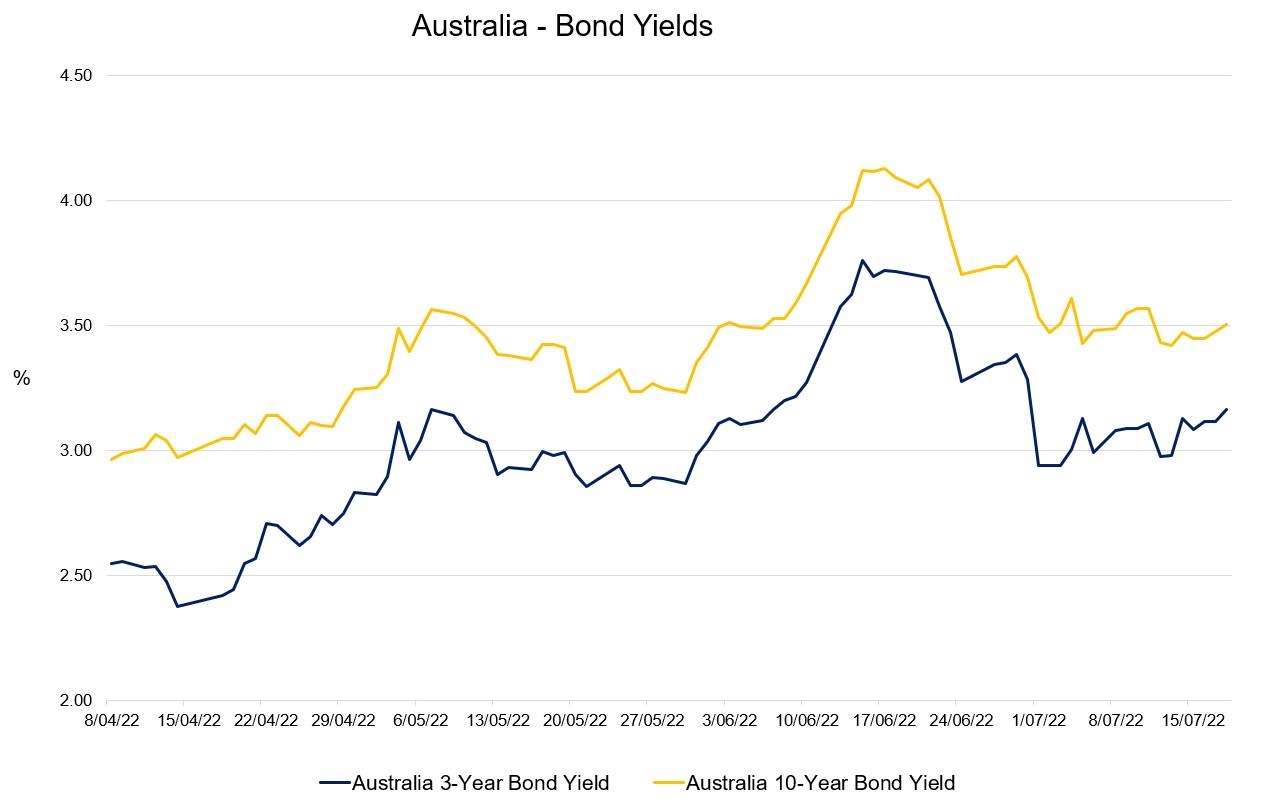
But while further interest rate hikes this year are a certainty, benchmark bond yields have dropped by around 60 basis points from  their highs.

Hopefully by 1 February Aussie households and consumers should have more confidence that interest rates aren't going to keep rising on them.


A timely boost for sagging stock markets here too, you'd think. 

---

Fuel prices...on the way down!


Source: CommSec

Friday, 15 July 2022

CBA updates interest rate forecasts

2022 hikes

After the strong employment numbers, CBA now sees the cash rate rising to 2.60 per cent by November - while also predicting a terminal cash rate for this cycle of 2.60 per cent. 

This trajectory means 50 basis points of hikes are coming in both August and September, before a probable pause in October. 


Source: CBA

CBA sees a 'neutral' cash rate as being around 1.50 per cent.

This is expected to be a significantly contractionary setting, then, to be followed by 50 basis points of cuts in the second half of 2023. 

In the short term, data is expected to keep running hot, while the forward-looking indicators continue to deteriorate sharply (consumer sentiment is already deeply pessimistic). 

Headline inflation is expected to peak at above 6 per cent, according to CBA Chief Economist Gareth Aird. 

Thursday, 14 July 2022

Unemployment rate drops to 50-year lows

Jobs for all!

It looks like all those job vacancies are now being filled!

The June labour force figures saw an outstanding increase of 88,400 to employment, to a record high of 13.6 million, again driven by full-time roles.

The past year has been a real rollercoaster ride, but over the last 12 months the increase in employment has been a very solid 3¼ per cent. 


Queensland led the way with a massive +4.6 per cent increase in employed persons, equating to an increase in employment of +123,000, with New South Wales also looking very strong. 


The labour force, meanwhile, has only increased by 1.8 per cent over the past year, despite a record high participation rate of 66.8 per cent, driven by an increasing share of females seeking employment.

This sent the unemployment rate plummeting to just 3½ per cent. 


Zooming in the unemployment rate dropped sharply from 3.90 per cent to 3.50 per cent in June, which is the lowest figure since the monthly data series began in 1974.


This drop was correctly anticipated by the ABS job vacancies and labour force figures, and indeed it's possible that an ever lower result could yet be posted. 


In saying that, SEEK's job ads figures are now in decline, and building and construction firms are going bust left, right, and centre, so as some point we'll see these excellent figures going into reverse gear. 

Hours worked in June were only flat, in part due to staff absences. 

---

Detailed analysis as always from James Foster here