Monday, 7 October 2019

Return of the Hi-Vis

Hi-Vis in WA

There are few better indicators of the vibrancy in resources capex than the volume of reversible fluoro at Perth Airport.

And lookie here, at 4.20am on a Monday morning...


Nice to see, with photo credit to ANZ Economist Cherelle Murphy on the Twitter.

Sunday, 6 October 2019

Saturday, 5 October 2019

Funky and new, Coorparoo

All new Coorparoo

It's a challenge to remember what the centre of Coorparoo used to look like now - and just how dated it all really was - but here's a reminder from nearly five years ago.

Well, it is not so any more!

First there was the demolition derby of 2015.

And then the developers moved in until 2017 (the peak of the apartment construction cycle, which has now long since been and gone).  

Coorparoo is really going places, and the Coorparoo Square project has been a fantastic success.

Cinemas, restaurants, coffee shops, and shopping, right in the heart of the suburb make it a very pleasant place to hang out these days. 


The coffee shops are buzzing from very early in the day now.


The apartments all formed part of a great swathe of higher-density construction through the most recent cycle, but in these parts they are now all happily tenanted, and achieving very decent rental returns to boot.


And with the skyline cranes now dearly departed, vacancy rates have been steadily tightening for a couple of years to be almost back in line with long run averages, following a great spike around 2016-17.


Source: SQM

The laneways and arcade are excellent and cool (I mean literally cool, which in a Brisbane summer is a massive plus) with a respectful nod given to the old Myer stores which once stood on this site. 


Overall, this is now a great place to entertain time, as well as to shop.


It's a big thumbs up for Coorparoo, one of my favourite Brisbane suburbs with A1 connectivity to the heart of the City. 

This is why you should raise your financial thermostat

Wealth thermostat

Here's why you should do it (or click the image below).


One small step for unemployment

Lowest unemployment since 1969

We're all watching closely for signs of a recession, but the US employment data continued to confound with the unemployment rate dropping by 0.2 percentage point to 3.5 per cent.

That's the lowest unemployment rate in the 50 years since May 1969, and marks the 19th consecutive month below 4 per cent unemployment. 

Who could've predicted this expansion back in 2009 (and still no inflation!)?


There were record low unemployment rates for Hispanic and African Americans.

Headline growth in nonfarm payrolls wasn't especially strong at +130,000, but combined upwards previous to preceding months totalling +45,000 kept the 3-month average growth at a very solid +157,000. 


However, average hourly earnings were little changed in the month (down 1 cent), which took the annual earnings growth down to +2.9 per cent, for the slowest result since July 2018. 


Inflation expectations continued to sag to below 1.5 per cent, to sit at the lowest level since 2016, so interest rates will probably still be cut according to market expectations. 

Correlations to returns

It's amazing to see the longest expansion continuing to push down unemployment even now. 

For investors in the US stock market, it is worth remembering the relationship between the unemployment rate and stock market returns - which is to say, low unemployment means low expected future returns, and this time will be no different.

The strongest forward total stock market returns are invariably seen when unemployment is high, and sentiment is low. 

Weekend reads

Must see articles

This week over at Property Update there's a look at latest rate cut and what that's going to do, and at the plunging trend in building approvals.

See here for more (or click the image below):


You can subscribe for the free Property Update newsletter here.

And for the free podcast, where I appear from time to time, check out here!

Threads & treads

Retail disappoints

Didn't get around to it during the week, so here's retail in 30 seconds.

There had been some expectation that tax cuts might partly flow through to retail turnover in August, but it didn't much happen.

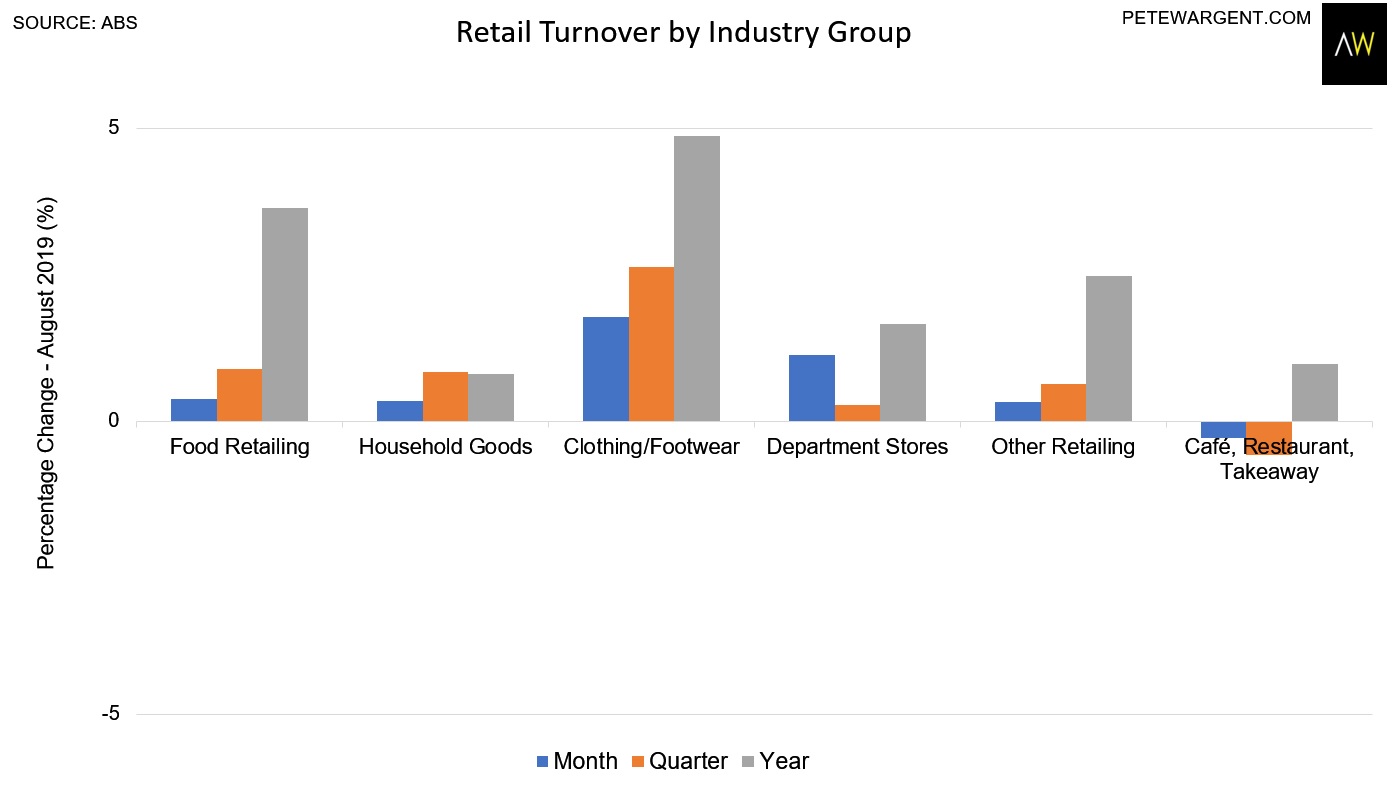
Retail turnover missed expectations in increasing by +0.4 per cent to $27.55 billion, while the prior month's growth was revised up a notch to zero. 


If you were trying very hard you could say this takes the annual growth up to +2.6 per cent, but the trend has been lower now since the second half of 2018.


To the extent that tax cuts were spent in the shops in August this was reflected in department stores (+1.1 per cent), and especially clothing and footwear (+1.8 per cent). 


And at the state level, Queensland now leads the way, with turnover up by +5.1 per cent over the year. 


Overall, there were some signs of tax cuts being spent on discretionary items, but not enough to lift total retail trade meaningfully.