Wednesday, 17 August 2022

Wages growth limps

Wages growth lame

Bank wages data has told us for months that wage prices growth is only modest, despite many concerned claims to the contrary.


Well, I guess we can put that one to bed, for the time being at least. 

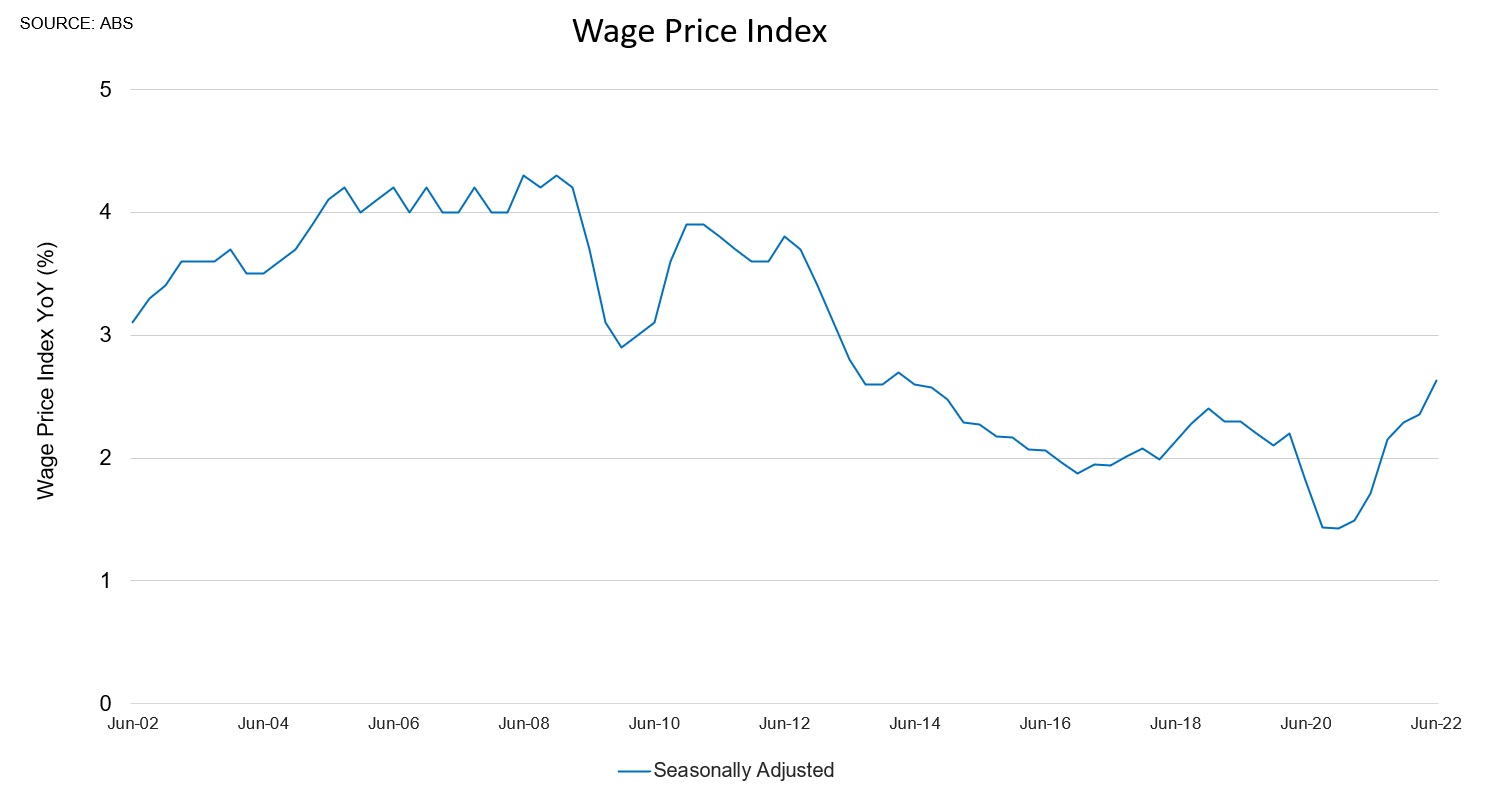
Wage price growth was once again lame at 0.7 per cent in Q2, and 2.6 per cent over the financial year. 

Both measures missed expectations to the downside...again.

Just for context, headline inflation is forecast to hit a lazy 7¾ per cent by the end of the year. 


Public sector wages growth was only 2.43 per cent, and for the private sector it was just 2.65 per cent.


Queensland recorded 2.9 per cent wage price growth, the fastest growth since 2013, and Tasmania was a relative bright spot. 

At the other end of the spectrum, the Northern Territory recorded wages growth of just 2 per cent. 


Neatly summarised, as ever, by the outspoken Mr. Keane:


Quite.

Tuesday, 16 August 2022

From Paris to Berlin...

Arrivals rebounding fast

Overseas arrivals into Australia increased much, much faster than expected in July.

The revised figures for May and June were 650,500 and 730,300 respectively.

Meanwhile the provisional estimate ballooned to 1,083,240 for July, a huge increase and way ahead of what analysts had expected (admittedly with finger in the air estimates). 

Of course, this remains well down on the record high for the month of July of more than 2 million arrivals which we saw in 2019, but it's certainly a hell of a lot better than the 87,000 (!) we saw the same time last year.


Source: ABS

Closer to pausing

This adds to the case for slowing down the pace of monetary tightening, for a couple of reasons.

Firstly, because the rapid acceleration in arrivals will soon help to ease labour force capacity constraints, especially as the international students and backpackers begin to pour back in to the country.

And secondly, because while the lack of ability to travel overseas was hugely stimulatory for Australia's economy up until the end of 2021 - as Aussie dollars were trapped at home to slosh around the consumption economy - this dynamic no longer holds true. 

Now Aussies can travel abroad, and hailing one of the wealthiest nations per capita on earth, they are doing so en masse...and spending profusely as they do so on the evidence I've seen in Europe! 

That's a timely boost for economic activity in Rome, Athens, Paris, Berlin, London, and Madrid, no doubt...not so much in Australia, though. 

Noted Lord Pascoe of the Twitter shire:


The spate of new arrivals will put pressure on rental markets on rents, granted, but that could be solved quickly and easily enough: by letting landlords refinance /borrow again. 

Rental markets under pressure

Rental pressures switch focus

There were signs of easing pressures in regional markets in July, as employers bring workers back to their offices in the big cities, according to SQM Research. 

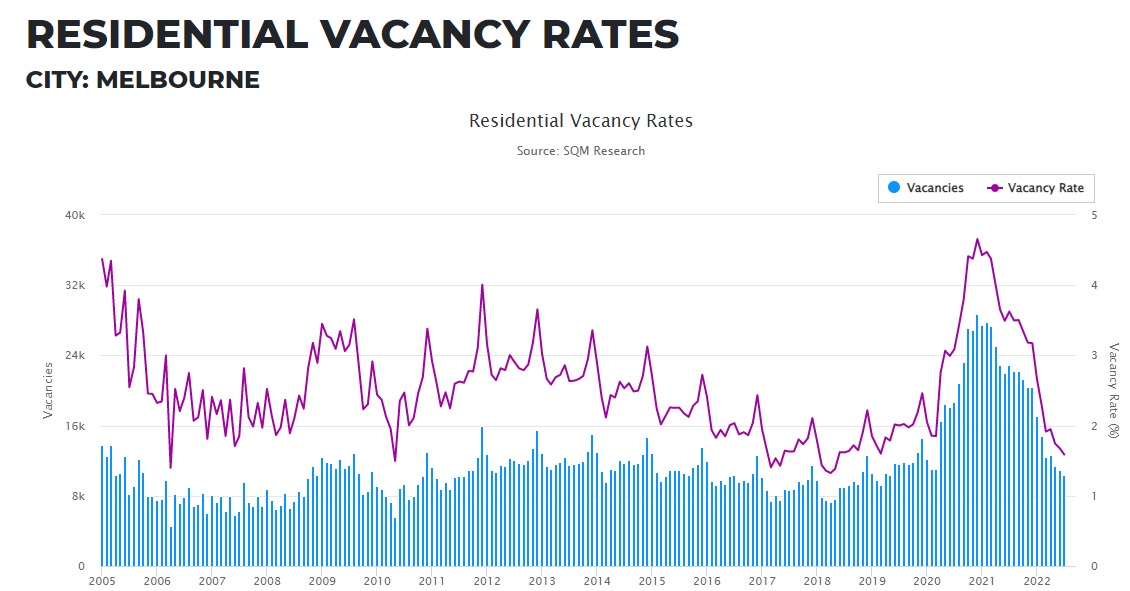
In Sydney and Melbourne, on the other hand, rental markets are tightening quickly, and even CBD rental vacancy rates are down to well below average.


With the ramp in immigration largely likely to impact Sydney and Melbourne, those rental markets are set to keep tightening, while there are also far few high-rise apartments towers being built now.

There aren't the foreign buyers around for developers to secure the requisite pre-sales, and construction insolvencies are surging in any case.

Capital city asking rents rose another 1.2 per cent in the month, to be 17.2 per cent higher over the year. 

Louis Christopher of SQM Research was reported in The Australian stating that although rental markets pressures should ease for regional tenants, the same cannot be said for those in Sydney in Melbourne. 

WTI oil -5.2pc; lowest since January

Oil price retreats

Some welcome news on the inflation front as some more of the sting comes out of oil prices, down by more than 5 per cent today to the lowest levels we've seen since January. 

Weak China data was the explanation for today’s plunge.


This downturn has been reflected in some good news for fuel prices in Queensland.


There's a bit of a sting in the tail here, though, with the fuel excise cut of 22.1 cents per litre due to expire at the end of September. 

There's a similar trend afoot in the US, with gas prices falling to a 5-month low of $3.95/gallon.


The US dollar weakened a bit today against the Aussie on soft business conditions, manufacturing, and other data (1 Aussie dollar is now buying just over 70 US cents). 


Hopefully this won't hurt either, putting a little bit of further downward pressure on domestic inflation. 

Monday, 15 August 2022

Labor to kickstart record immigration

Record migration program

As in many developed countries, Australia's economy has been grappling awkwardly with capacity constraints.

The cavalry will soon be on the way, though!

Visa processing is being fast-tracked, there are now on average some 10,000 student visa applications per week, and the Labor Party - having being essentially silent on population policy plans through the election campaign - is now reportedly looking to ramp up the immigration program to 200,000 per annum. 

As the number of temporary visa holders rebounds, it's entirely possible that the growth in resident population could reach or exceed a record high of 500,000 per annum over the next couple of years, after accounting for the natural growth of the population of around 150,000 per annum (i.e. births minus deaths).

For the time being, at least, tens of thousands of Aussies are taking a well-earned break and travelling overseas, but the return of international students appears likely to take some of the pressure off the labour market as we head into the summer months. 

Week ahead

There is a huge data dump due out this week, so let's take a quick preview of some of the key releases.

Firstly, while overseas departures are riding fast (increasingly so as the rising number of short-term arrivals begin to cycle back out), we'll start seeing monthly arrivals come surging back to above 1 million over the coming months. 


Wages growth is likely to come in at around only 0.7 per cent or 0.8 per cent for the June quarter, perhaps allaying some of the concerns of a 'spiral' in incomes (wages growth is also rebounding from record lows in 2020). 


The jobs release is another hugely important and anticipated  data series; and looking at jobs vacancies figures it's likely to be another very solid set of numbers. 


The unemployment rate is already very low at just 3.5 per cent, after a huge drop last month. Will it fall even further this month? Naturally this could further inform monetary policy if so. 


Turning point

The Sydney Morning Herald reported upon a symbolic turning point for the big smoke today, as 60,000 runners showed up for the resurgent City2Surf, while the SCG was a packed house of 44,500 for the Sydney Swans game (the third highest ever AFL crowd at the cricket ground).

Sydney is back, read the headlines!

In a similar vein, SQM Research will report a national residential rental vacancy rate of just 1 per cent for July, with rental pressures easing in Adelaide, Hobart, Perth, and Canberra respectively, but with clear signs of a huge rotation back towards Melbourne and Sydney, both of which will record another drop in rental vacancy rates. 


Source: SQM Research

Rents are continuing to accelerate across the capital cities, according to CoreLogic's latest figures. 


Sentiment shift

There has been some evidence of a sentiment shift in the property market over the past week or two, with rents and now auction clearance rates both rising, immigration about to surge towards record highs, and fixed mortgage rates falling back following some alarming spikes. 

Consumers are perhaps starting to believe that the terminal cash rate for this cycle may not be quite as bad as previously feared.

There is a missing piece in the housing market puzzle, though, and that's the massive 3 per cent assessment buffer on new loans, which will be far too high from next month, and will stymy the ability of landlords to borrow and supply badly needed new rentals.

In fact, plenty of landlords have actually been choosing to offload rental properties due to their ongoing inability to refinance, punitive changes in land tax rules, ever-trickier tenancy and ‘no eviction’ laws, as well as rising mortgage rates and trades/renovation costs. 

Friday, 12 August 2022

Student visa applications explodes to life

Student surge incoming

Bloomberg reported today how Hong Kong is tragically becoming dead in the water as an international destination.

Hong Kong experienced its greatest population decline in more than six decades, as more than 120,000 residents left for overseas due to their rights and freedoms being curtailed. 


Student visa applications for Australia, meanwhile, are now exploding, up to an average of 10,000 per week. 


It looks like a backlog of tens of thousands of Australian visa applications are set to be fast-tracked from here to tackle the skills shortage and take pressure off labour market capacity.

There are reportedly more than 900,000 visa applications outstanding, with over half a million of the applicants presently located overseas. 


Most new international arrivals - and especially international students - are renters initially, and overseas "for rent" searches have suddenly surged to be 75 per cent higher than their June 2020 lows. 


Source: PropTrack

Some further pressures on rental markets ahead. 

Lending buffers too tight

In obliquely related news, from the mortgage broking space, from next month loan approvals will be based on an implied cash rate of 5.35 per cent, which is far, far too high, and crippling property market activity. 

Recently discussed further here


MOAR of the same! Producer prices fall...

Producer prices fall

More of the same today, as producer prices have actually begun to fall, with a few fresh charts from the Bloomberg.

Ocean freight rates fell another -1.5 per cent last month, as supply chains continue to gradually resurrect themselves. 

Take a look at the speed of the decline from the 2021 peaks...


PPI goods (at final demand) fell -1.8 per cent in July, which was a huge reversal and the biggest drop since April 2020.  


And so producer prices are rolling over, with the monthly index down by some -0.5 per cent, and the year-on-year result of +9.8 per cent thus way better than the expected +10.4 per cent. 


Excluding food and energy, producer prices were up +7.6 per cent over the year, well down from +8.2 per cent a month earlier. 

The wrap

An outright decline in producer prices for the month is an even more welcome surprise than the flat consumer prices figures reported yesterday. 

The Federal Reserve will still be delivering a few more rate hikes from here, of course, but the odds of pulling off a soft landing appear to have improved markedly. 

No doubt there will be some hiccups along the way, but it's getting steadily harder to believe than inflation won't be transitory now. 

Thursday, 11 August 2022

Wage & inflation expectations drop substantially

Tightening impacts

New home sales fell 13.1 per cent in July, as a result of increases in the cash rate target, according to the HIA:


Inflation expectations fell sharply from 6.3 per cent to 5.9 per cent in the Melbourne Institute's August report, well down from the highs. 


Notably, wage expectations also fell substantially, thereby underscoring little indication of a wage price spiral, according to the MI.