Friday, 4 February 2022

Housing approvals slip sliding away

House approvals to fade

There was a tidy bounce in unit approvals in December, driven by Melbourne developers anticipating a resurgence in demand as borders reopen. 


Private sector house approvals of 10,444 were 21.3 per cent lower than a year earlier, however, as the HomeBuilder stimulus effect wears off. 

Overall, the trend for house approvals is likely to slow quite significantly over the next year, acting as a drag on growth (and inflation in materials and trades services). 


Building approvals have been very sprightly through the past year, but the rolling annual total for approvals has gradually slowed since September 2021 from 232,000 to 228,000 at the last count. 

The government's advertising campaign to bring back the backpackers suggests we might expect to see the immigration lever pulled quite hard over the period ahead. 

---

James Foster with the detailed analysis here

Wednesday, 2 February 2022

How to self-fund retirement with a property pension

Property pod

On this week's Property Pod, I asked Bushy Martin whether everyday Aussies can self-fund retirement with a property pension.

Tune in here (or click on the image below):

You can also tune in at Apple, Spotify, etc. 

Oh, and Youtube!

Tuesday, 1 February 2022

Housing finance resurgent in January

Loans power back

There's been some talk around industry circles about strong housing lending, defying the doom and gloom narrative in the mainstream media. 

And the December numbers confirmed as much, with total housing lending (ex-refinancing) increasing to surpass previous highs, at $32.8 billion. 


Investor lending was solid (up 2.4 per cent in the month), and owner-occupier lending rebound (up 5.3 per cent) was largely driven by the backlog in Sydney and Melbourne as those cities reopened in Q4. 


The average loan size for existing dwellings increased to a record high. 


The same was true for all owner-occupier loan types, with six of the eight states and territories seeing loan sizes hit a record high. 

Detailed analysis from the data king James Foster here

---

The Reserve Bank wants to see stronger wages growth before moving on interest rates. 

So probably forget any changes in the cash rate until...September, at the earliest. 

Listings dropped in January

Listings tighten

There was some headlines this week about vendors rushing out of the housing market.

It's probably a bit early for that kind of reporting. 

Yes there will be more listings, as the market reopens.

But total listings actually fell 8 per cent in January, to be 24 per cent lower than a year earlier. 


Stock levels were very tight in Brisbane, Adelaide, and Canberra, in particular. 


Those are some big year-on-year drops. 


Older stock is still clearing well, and housing lending remains robust. 

Monday, 31 January 2022

Here come the backpackers

Backpackers to return

A new $7 million advertising campaign has been launched to bring back the backpackers to Australia.


Source: Aus Gov

I'm too data-jiggered to dig out the old visa charts, but the record high for backpacker visas was over ¼ million.

After a few days driving the east coast - a timely reminder of what a superb country Australia is for travellers - I reckon we'll top that figure in the not-too-distant future. 

Credit was flowing in late 2021

Credit gap opens

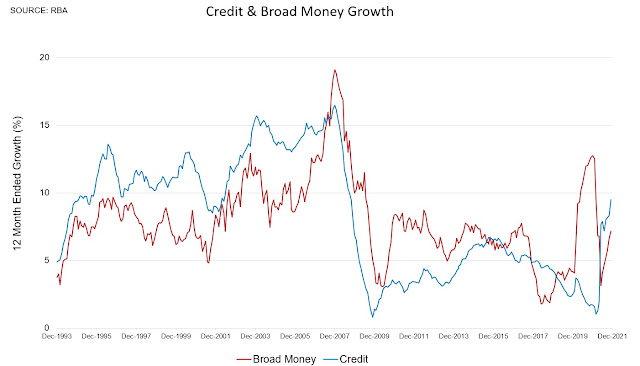
Credit growth was strong in December, with back-to-back strong months of business lending taking business credit growth up to 8.4 per cent for the 2021 calendar year (following negligible growth in 2020).

Credit growth in the economy overall increased to 7.2 per cent, for the strongest annual result in 13 years. 


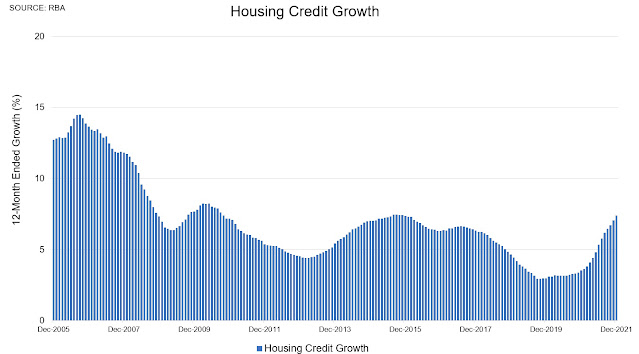
Housing credit growth increased to 7.4 per cent for the year, recording steady results over the last couple of months of the year. 


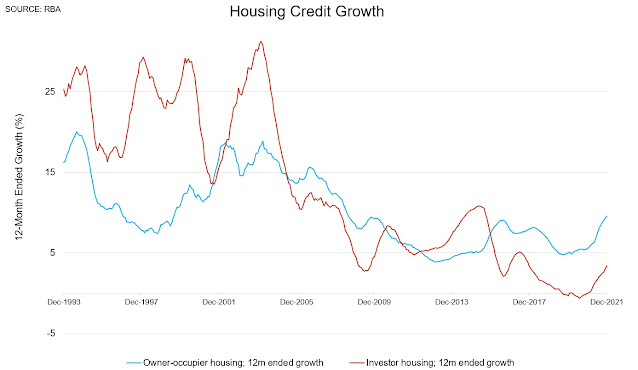
The growth in housing credit continues to be dominated by owner-occupiers, although the investor cohort has picked up some momentum, albeit from record low credit growth.


It's hardly much to stress about, given the average Aussie household is now almost four years ahead on their mortgage repayments, while households are sitting on an unprecedented almost $½ trillion in savings. 

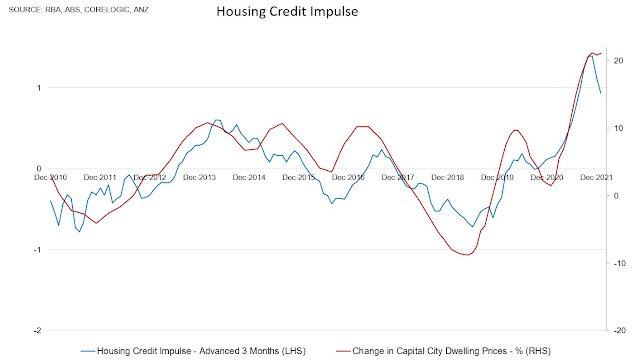
The housing credit impulse is also cooling. 

The January figures will show housing prices up 21 per cent year-on-year, but annual price growth for property will evidently fade from there, while new listings are now on the rise. 


We'll still have to see how January plays out, given everything that's happened since Christmas, but the stimulus was certainly working its magic late into 2021. 

---

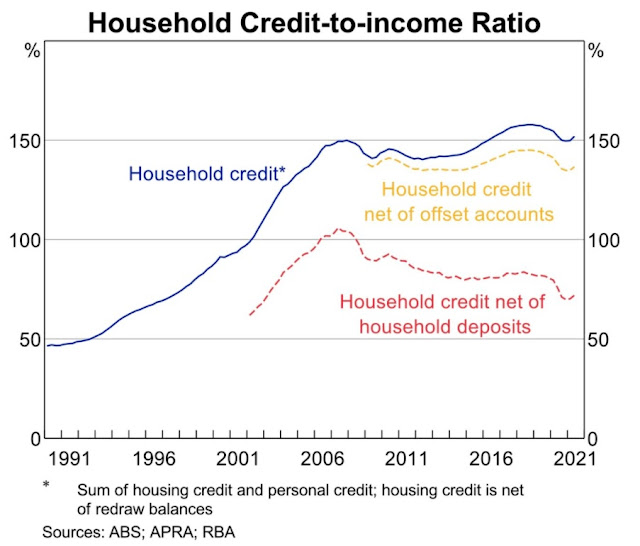
Edit: Household credit to income is essentially unchanged since 2005; while net of deposits, the ratio has declined comfortably.  

(h/t Stuart Wemyss).


Source: RBA

Friday, 28 January 2022

Reaching for yield?

Rising rates

I discussed the hot topic of inflation and rising mortgage rates here on ausbiz TV (or click on the image below): 

Tuesday, 25 January 2022

Inflation back in the target band

Inflation stirs a bit

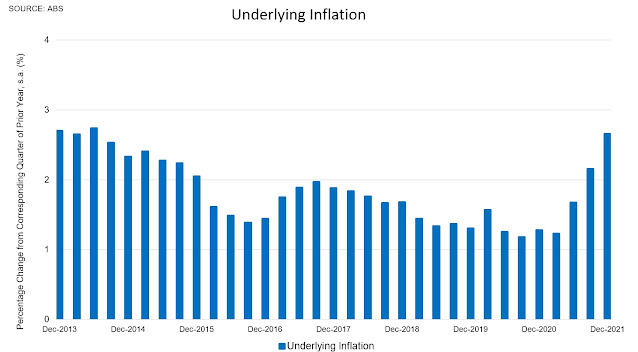
Muchos excitement on the social media as annual underlying inflation increased to 2.63 per cent for the trimmed mean measure (and 2.68 per cent for the weighted median). 

So inflation is, for now, well and truly back in the target band, after a long hiatus. 


Headline inflation came in at 3½ per cent.

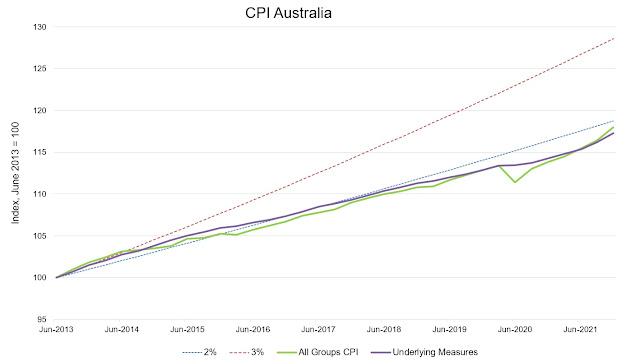
On a cumulative basis inflation has been very low over the past 5 or 6 years, leading many commentators to call for a lowering of the target to 2 per cent (though not so much today, I note!).


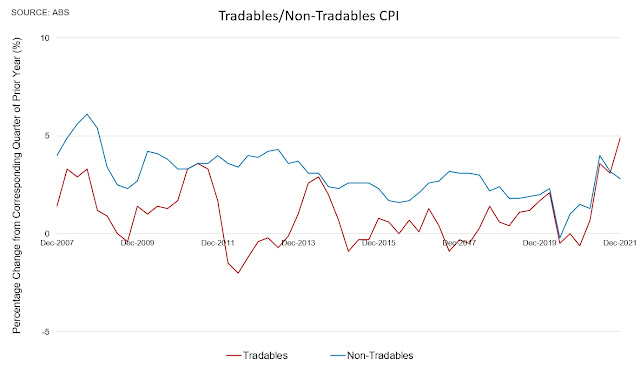
Tradables inflation was high at 4.9 per cent in 2021; while non-tradables inflation was considerably lower at 2.8 per cent. 


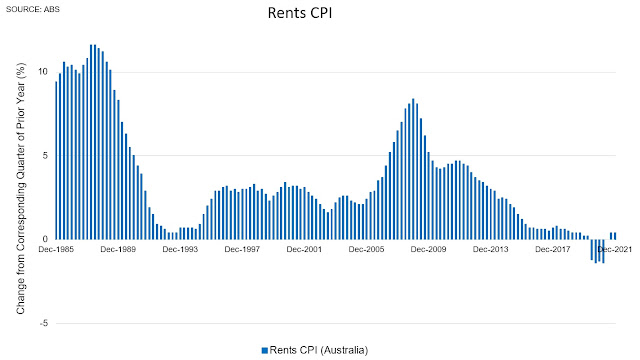
The ABS measure for rental prices picks up the capital cities, and possibly lags a little, coming in at only 0.4 per cent in 2021, far lower than in previous cycles. 

The wrap

Overall, this was a strong reading, with inflation driven by fuel, food, and in particular new dwelling costs (up by another 4.2 per cent in Q4, after a 3.3 per cent increase in Q3).

The Reserve Bank may not be in a rush to hike though, given that annual wages growth is 2.2 per cent, and expectations for pay rises are still anchored at low levels. 

Fiscal support will also be wound back over the next year or two, and it's not yet clear how the economy will track when the massive fiscal support is withdrawn. 

In any case much of the inflation relates to supply chain issues in 2021, which will be mostly resolved later in 2022 - certainly for food and new dwelling costs - so hiking interest rates while real wages are negative possibly wouldn't serve much useful purpose. 

Still, stock markets didn't like it much, the XJO being down over -3 per cent at 6,923 (public holiday tomorrow, so there will be no rising from the dead today).