Wednesday, 12 January 2022

Get set for pay rises++

Job vacancies at all-time high

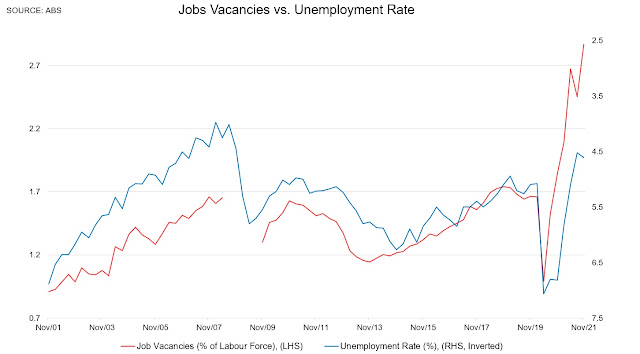
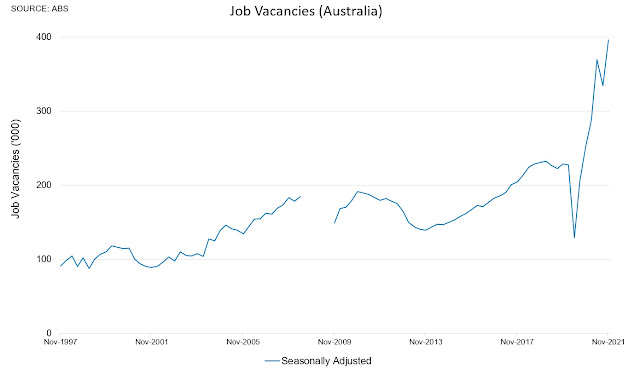
A welcome break from the endless jabbering on coronavirus case numbers and absurd immigration rules shows job vacancies tearing to an all-time high of 396,100 in November, for a thumping 59 per cent year-on-year increase. 

Job vacancies in November were absolutely miles above their pre-pandemic levels. 
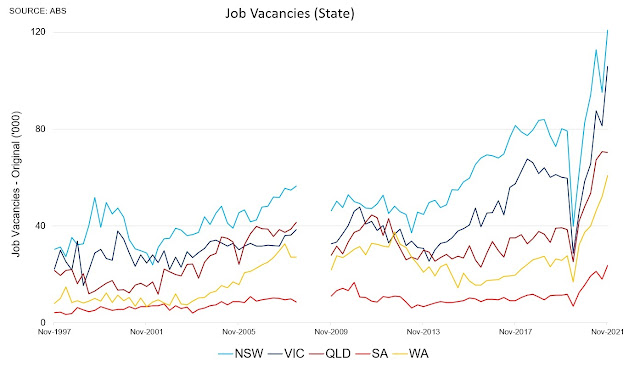
New South Wales saw an all-comers record of 120,900 job vacancies, while Victoria wasn't too far behind at 106,000, with substantial year-on-year increases seen across the board. 

The massive stimulus has kept demand ticking over, in some sectors of the economy at least, and we've basically never seen anything like this before.

The labour force has shrunk a little in recent months due to lockdowns to 13.8 million, so you can't read too much into the below chart, which has a bit of an artificial ring to it right now given ongoing disruptions.

But at face value if the job vacancies were to be taken up in due course the unemployment rate would drop like a stone to under 3 per cent, inevitably resulting in strong pay rises. 

I get that all this is divisive issue - heck, people on my Twitter feed are calling for permanent border closures, the construction of quarantine camps, lockdowns for the unvaccinated, making unvaccinated people pay for their own healthcare, and goodness knows what else.

Whatever, it's a personal blog: Australia needs to get the borders open as soon as practicable so that business and supply chains can function properly. 

---

OK then, just a short note on the unmentionable.

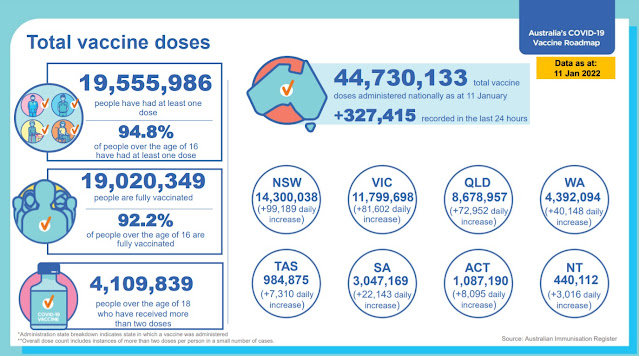
The booster stroll-out gathered a little pace today, with a further 242,629 boosters delivered in 24 hours, taking the total of boosters to 4.1 million. 

In total, some 44¾ million doses have been delivered up until January 11. 
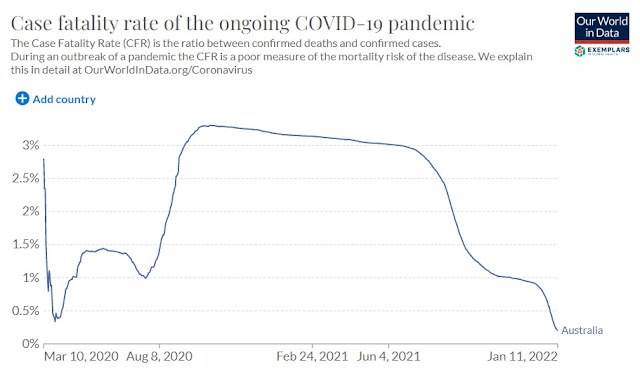
Mercifully the case fatality rate of the Omicron strain has proven to be considerably lower, as has been evidenced elsewhere in the world. 

The latest figures for Australia show a CFR for COVID-19 falling to just 0.2 per cent at the last count, down from 3.3 per cent a year earlier.

Monday, 10 January 2022

Sydney unit supply dries up

Unit approvals fizzle

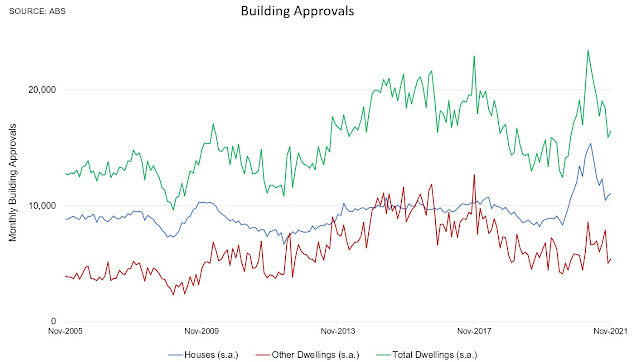
Only 757 units were approved in Sydney in November - with Delta disruptions probably a factor - as low as we've seen for a monthly total in about a decade. 

I think we'll end up with a unit shortage in Sydney, and sooner than people expect (so does Tim Reardon, Chief Economist of the HIA). 


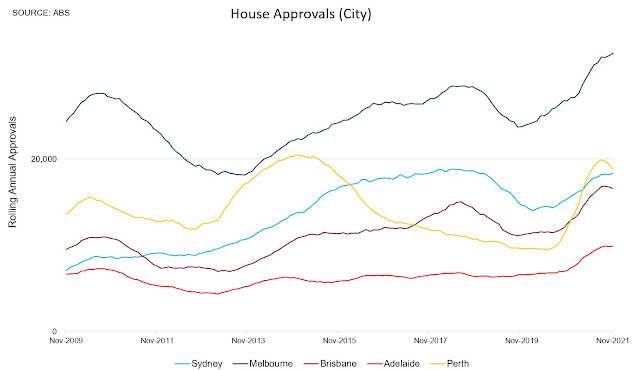
Perth's boom in detaching housing construction appears to be rolling over, and perhaps the same holds true in Brisbane and Adelaide as the government stimulus effect fades. 


Overall, though, it was still a solid enough release with 16,448 approvals in November, seasonally adjusted.

Over the year to November, there were more than 229,000 dwellings approved, which is a very strong annual number...albeit now fading. 

Most likely dwelling construction will fade through 2022, thus in time becoming a headwind for the economic recovery. 

You can find more comprehensive details,  as ever, from data king James Foster here

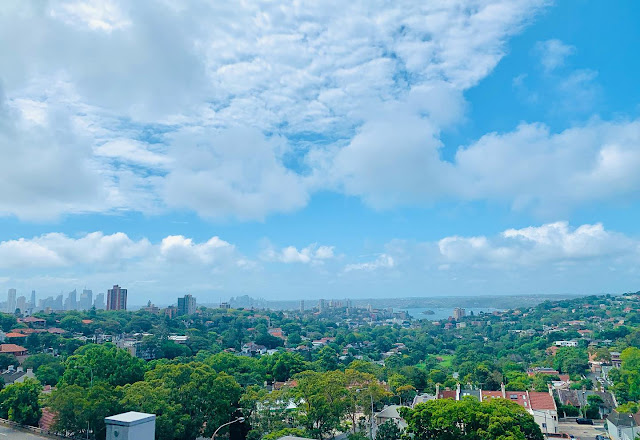
In Sydney today myself, and staying in town for a couple of weeks - my first visit in a YEAR.

What to expect in property in 2022?

Property in 2022

If anyone knows after all these years (decades!), it would have to be real estate supremo Michael Yardney, so I interviewed him on this week's podcast.

Tune in here (or click on the image below):

Saturday, 8 January 2022

Fed to hike in March (unemployment 3.9pc)

Unemployment drops again

A fair miss on hiring in December, with U.S. nonfarm payrolls coming in at +199,000, against +400,000 expected.

Revisions to the October and November figures added back a further +141,000, however.

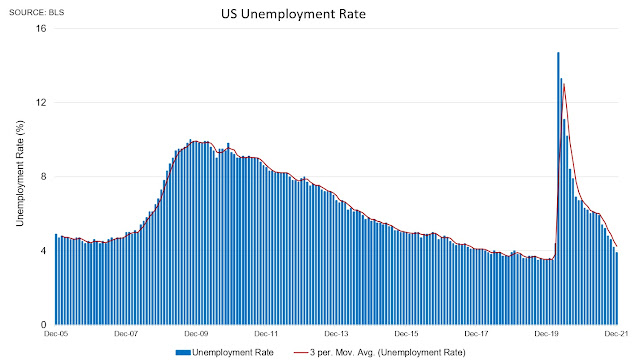
And still, the unemployment rate dropped sharply again, now down to just 3.9 per cent and approaching the pre-pandemic lows. 


Just as an aside: what a remarkable recovery that's been, from nearly 15 per cent unemployment in April 2020!

Average earnings growth was also solid, up +0.6 per cent for the month in December, and +4.7 per cent for the year.

The Federal Reserve is now 90 per cent likely to be hiking interest rates by its March FOMC Meeting.

Don't fight the Fed, right? :-)

Wednesday, 5 January 2022

Carry on up the charts

Fixed rates on the rise

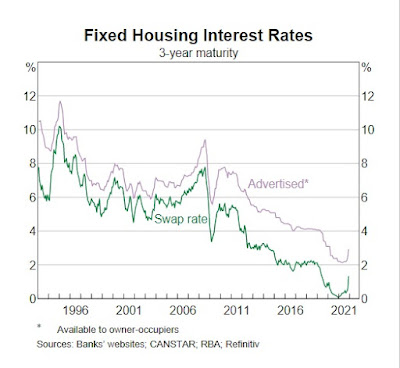
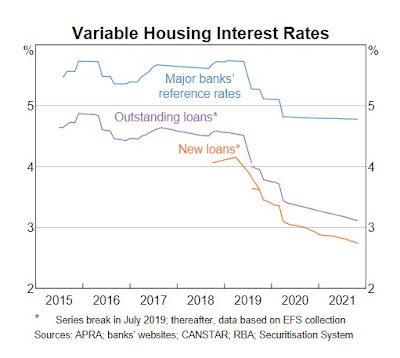
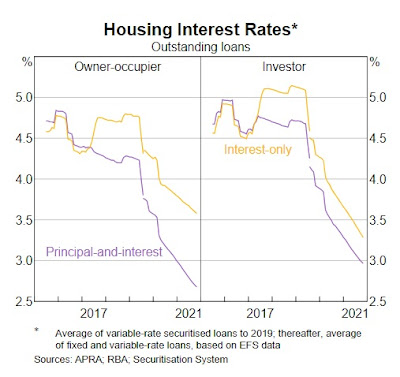
Nothing 'new' here, as such, but some interesting chart on fixed and variable mortgage rates from the Reserve Bank.

Fixed mortgage rates are now on the rise, and quite sharply...


Variable rates, on the other hand, are not...


Finally on the subject of interest rates, if you haven't done so already, it would possibly be smart to speak to your mortgage broker about refinancing given the marked shift in mortgage rates over the past couple of years!


You can track down the full RBA Chart Pack here - with some very interesting insights, as always. 

---

Spending returns in Q4

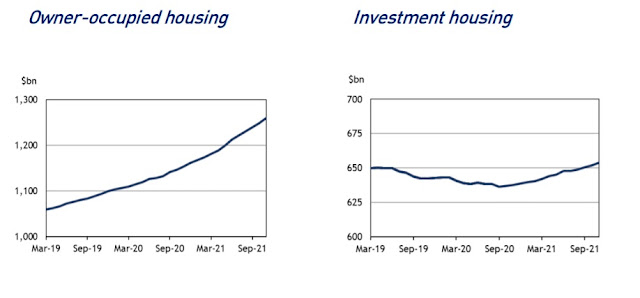
Separately from APRA, housing investment loans are now back up to where they were a few years ago.

Lending to owner-occupiers still had some life in November, increasing by a relatively strong 0.9 per cent, with investment lending up by a more modest 0.3 per cent. 


Source: APRA

While CBA has been gaining mortgage market share, ANZ has continued to struggle with a blowout in mortgage processing times. 

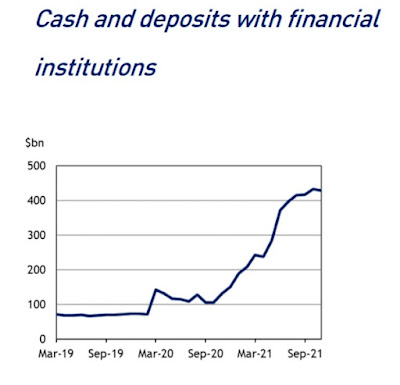
Following an unprecedented surge. cash and deposits with financial institutions have finally begun to run down, declining by about $5 billion or 1.2 per cent in November. 


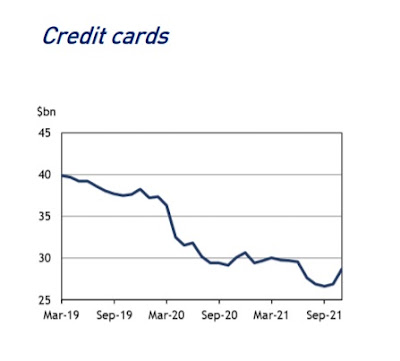
And there was also some sign of credit card activity bouncing, with lending up 6 per cent in November, suggesting that households were beginning to spend again before Xmas, reflecting the easing of restrictions and improved economic conditions, according to APRA. 

Despite this, credit card lending remains well below historical averages. 


The full statistical release from APRA can be found here

Makes a nice change from reading about antigen tests anyway.

Tuesday, 4 January 2022

Listings fell back in December

Listings decline

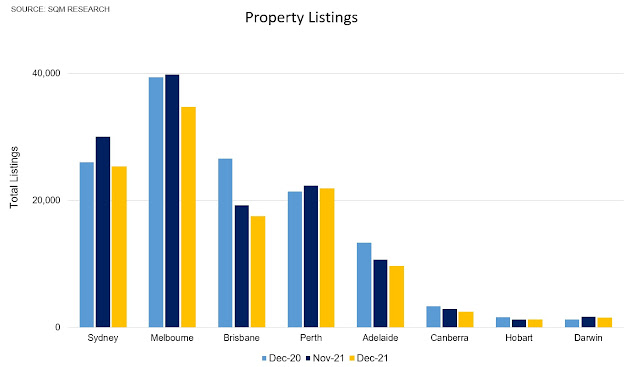
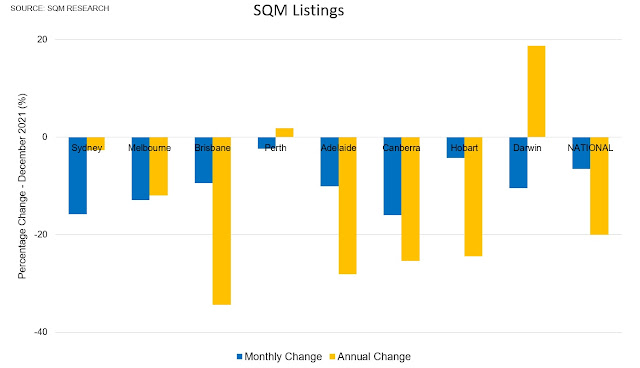
Listings dropped from 233,716 to 218,415 for a decline of -6.5 per cent in December, according to SQM Research.

The decline was led by sharp falls in Sydney, Melbourne, and Canberra, and listings were some -20 per cent lower than a year earlier (when there were 272,999 listings). 


Brisbane listings were -34 per cent lower than a year earlier, and there were also sharp declines in Adelaide (-28 per cent), Canberra (-25 per cent), and chronically tight Hobart (-24 per cent).

Darwin was the only capital city to see listings rise significantly over the year. 


According to Louis Christopher from SQM Research, overall there remained a shortage of listings at the national level in December, and as a result asking prices increased over the month. 

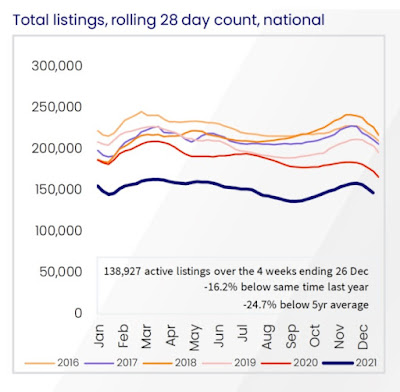
Separately, CoreLogic found listings to be -25 per cent below their 5-year average. 


Source: CoreLogic

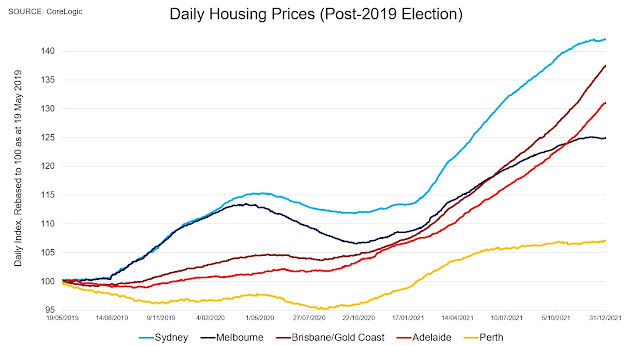
Over the calendar year, CoreLogic reported dwelling prices up 22 per cent, but with the rate of growth generally slowing in the capital cities towards the end of the year. 


Source: CoreLogic

Older stock is clearing

New listings fell -47 per cent in Sydney in December as vendors pulled up the ladder.

And aged listings over 180 days fell in half from a year earlier, in a sign that old stock is still clearing. 

Overall, there was no real sign of panic selling in the latter stages of the year.

On the contrary, quite an optimistic outlook beckons for property in 2022. 

---

You can find SQM's detailed release here

Monday, 3 January 2022

Pandemic migration, and the resilience of cities

Demographic trends

There were some notable demographic shifts in 2021, away from density, and away from the most locked down states, and not only in Australia. 

I took a look at some related thoughts here (or click on the image below):


Saturday, 1 January 2022

Melbourne house prices eased in December

Calmer waters

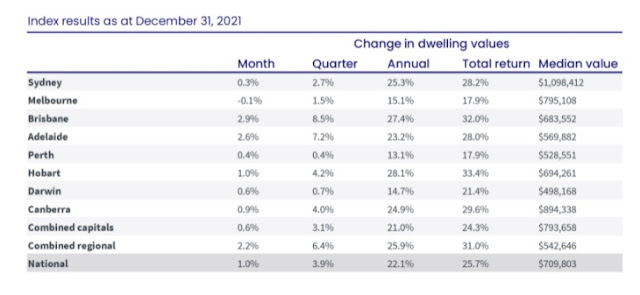
Melbourne house prices finished the month of December a little lower for the first time in 14 months, down by 0.3 per cent. 

Sydney prices also only increased modestly, to be up by 0.3 per cent.

Brisbane led the way with a significant 2.9 per cent increase in the month of December, for a thumping 8½ per cent quarterly rise.

Adelaide also recorded a strong monthly gain of 2.6 per cent, and house prices up by more than 7 per cent for the quarter. 

Perth recorded a 0.4 per cent monthly increase in prices. 


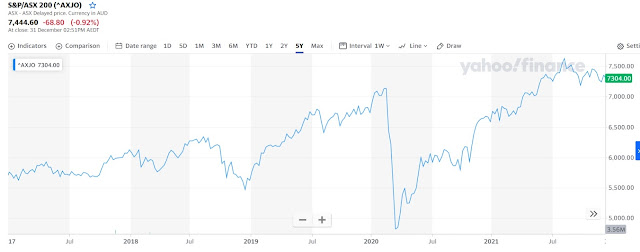
In the world of equities, Aussie stocks finished the year with an impressive 13 per cent gain, leaving the ASX 200 index higher than its pre-pandemic levels (and now about 12 per cent higher than the 2007 peak). 


Overall, then, household wealth has increased strongly in 2021.

The capital city house price index increased by around 21 per cent, substantially accounted for by Brisbane (28.4 per cent) and Sydney (25.3 per cent), as well as strong gains elsewhere. 

Superannuation funds have likely returned about 11-12 per cent for the calendar year, and stocks are clearly now well up from their 2020 lows.

Household wealth in Australia thus powered into the end of the year, probably exceeding $15 trillion, pushing the average net worth per capita up to a record high of around $575,000 (comfortably more than doubling over the past decade).